


Motezza Blog - Royal Enfield winter care
This is how we overwinter our Enfields at Motezza
Gerhard · Motezza · Greve in Chianti · 7-minute read
The air in Tuscany is milder than in the Alps, but it’s still humid. To ensure that our Classic 350 runs as smoothly after the winter break as it did on the first day, we take a systematic approach. Here’s our tried-and-true procedure: clear, concise, and no frills.
- Clean thoroughly and dry completely
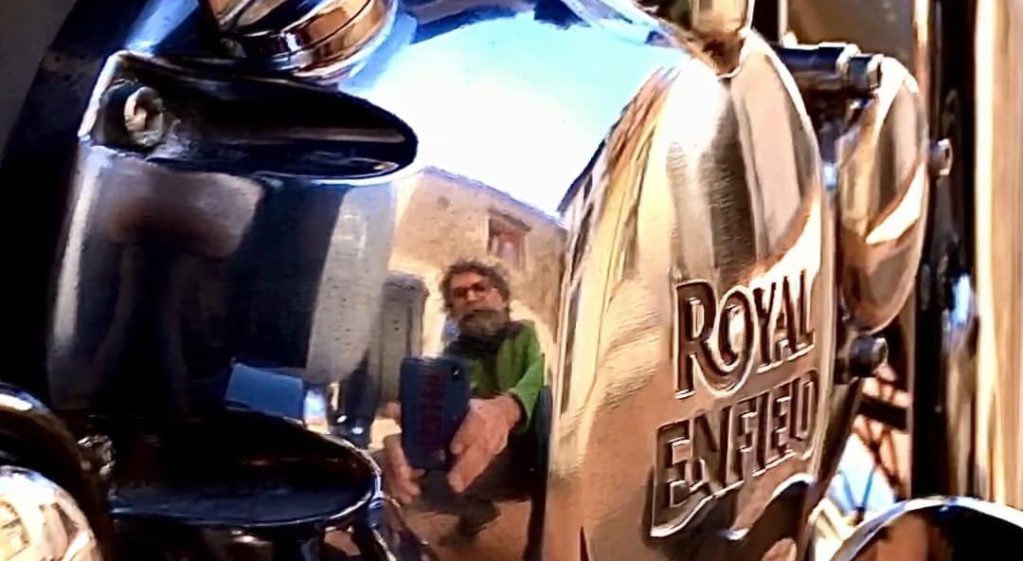
- Wax the paint and chrome, polish the aluminum motor housing by hand
- Charge battery via SAE connection with smart timer
- Fill the tank to the brim with fuel stabilizer; let the engine run for 5 to 10 minutes
- Lubricate chain and all joints
- Raise the motorcycle onto the center stand so that both wheels are off the ground; tire pressure: +0.2 to 0.3 bar
- Dehumidifying bag on the handlebars, breathable cover
1. cleaning
Rinse off coarse dust and dirt with clean water. We work with soft sponges and special brushes for rims and spokes so that nothing gets scratched.
We clean the chain before the rest of the bike so that no traces of grease run over the paintwork and chrome.
Use microfiber cloths and airflow; do not apply heavy pressure. Just dab down electrical connectors—never spray directly onto them.
2. conservation and care
All painted and chrome parts are waxed and polished. Unpainted metal surfaces, screws, and edges are treated with a very thin layer of corrosion protection—never on the brake discs.
- Aluminum motor housing: if necessary, polish by hand with metal polish and a soft cloth
- Easy care for rubber parts and seals to keep them supple
- Wipe stains on chrome dry immediately, avoid harsh cleaners
- Remove fingerprints after polishing
3. battery and trickle charge
Our Enfields have an SAE connection. We connect a smart maintenance device and control the charging via a smart socket in the fixed program.
Normal winter: every 14 days for 2 hours
In heavy frost: 1 hour per week
The maintenance unit can also remain plugged in permanently, but we prefer to use the timer.
Set the correct characteristic curve on the charger: 12 V, lead-acid or AGM. Never place the charger on live parts.
4. tank and fuel
The Classic 350 is a fuel-injected model, which makes things easier. We fill the tank to the brim, add the fuel stabilizer, and let the engine run for 5 to 10 minutes so that it circulates throughout the system.
- We sell E5; E10 is not currently available here.
- No winter short starts: condensation remains in the oil without a long drive
- Oil changes strictly according to the service interval; no additional oil change at the end of the season
5. chain and lubrication
Clean the chain with a suitable cleaner and soft brush, allow to flash off, then lubricate evenly with a spray suitable for O-rings and X-rings. Wipe off excess, check slack and adjust if necessary.
Bowden cables, lever and stand joints get a minimal drop of oil.
6. tire pressure and parking
We place the machine on the main stand and jack it up slightly so that both wheels are free. This prevents flat spots.
Pump 0.2 to 0.3 bar above the set value. Bring back to normal pressure before the first spring start.
A wooden or rubber pad under the tire contact surfaces helps to reduce flat spots. Since we have both wheels free, we don't need this.
7. parking space, dehumidification and cover
- Dry, well-ventilated, clean—no thick plastic tarps right around the motorcycle
- Use a breathable cover
- We hang granulate dehumidification bags on the handlebars so that they draw air freely and do not come into contact with metal
- Loosely cover the exhaust port with a cloth; remove it before starting the engine for the first time in the spring
8. first start in spring
- Remove the cover, remove the cloth from the exhaust
- Unplug charger
- Set the tire pressure to the target value
- Visual inspection: leaks, cables, tire condition, brake pads
- A gentle warm-up lap—everything feels alive again
After a good winter break, the Classic 350 rides in the spring like on the first day. This is no coincidence.
Gerhard - Motezza - Greve in ChiantiAnswered briefly
Why no winter short starts?
Without a longer ride, the oil won't get hot enough to evaporate condensation. Over time, this can damage the engine and exhaust. When you ride a motorcycle, do it right—or don't do it at all.
E5 or E10 over the winter?
We fill up with E5. E10 is currently not available here. With a fuel stabilizer, E5 is well suited for longer downtimes.
Does it make sense to change the oil at the end of the season?
We stick to the regular service interval and do not make any additional changes at the end of the season. When fresh, the oil does not cause any problems over the winter.
Remove the battery or leave it in?
Thanks to the SAE connector, the battery stays in the motorcycle. With a battery maintainer and Smart-Timer, it’s gently kept in good condition throughout the winter—no need to remove it.
What is the advantage of the smart socket when charging?
We can set the charging schedule—for example, every 14 days for 2 hours—without having to remember to do it ourselves every time. The maintenance device works reliably in the background.
Why keep the dehumidifier bag on the handlebars and not somewhere in the bike?
On the handlebars, they hang freely in the air, can draw moisture from the ambient air and do not come into contact with metal parts. This makes them much more effective than being clamped somewhere.
Do you like Motezza? Set us as a preferred source on Google.
Prefer on GoogleReady for the next season? Royal Enfield Classic 350, helmets included, unlimited kilometres and personal route tips from Greve in Chianti.
Make a note now